02 Biography
The man behind
a five-decade mandate.
Everything on this page is drawn from published corporate disclosures, board biographies, national honours reporting and the Mauritian press. Where the record is silent, this page stays silent.
i Introduction
A Mauritian business leader, documented
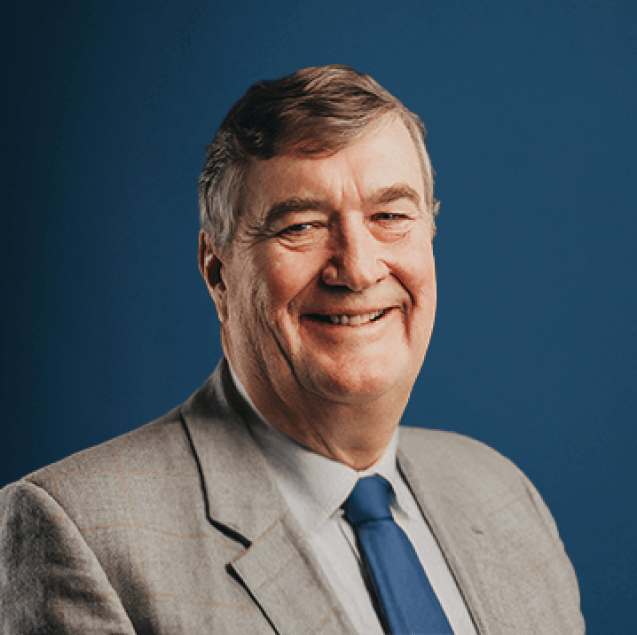
P. Arnaud Dalais is a Mauritian business leader whose professional life has been almost entirely bound to a single institution. He joined the CIEL Group in August 1977 and remained inside it for forty-eight years — as executive, then chief executive, then chairman — before stepping back from the chairmanship on 1 July 2025 while continuing to serve on the board as a non-executive director.
The bare chronology understates the change he presided over. CIEL was founded in 1912 and, for most of its first seventy years, was a company defined by sugar. By the time of the 2025 handover it was reporting six operating clusters — agro and property, textile, finance, healthcare, and hotels and resorts — a presence across roughly ten markets in Africa and Asia, more than 38,000 employees, and revenue of MUR 38.03 billion for the financial year to 30 June 2025.
He was appointed Group Chief Executive and Director in November 1991, became Group Chairman in 2010, and took the chair of CIEL Limited following the Group’s reorganisation in 2014, when the listed entity previously named Deep River Investment Limited was renamed CIEL Limited.
Outside the Group, he twice took on the role of speaking for Mauritian business as a whole: as Chairman of the Joint Economic Council between 2000 and 2002, and as Chairman of Business Mauritius between 2015 and 2017. He has been awarded the rank of Grand Officer of the Order of the Star and Key of the Indian Ocean (GOSK) by the Republic of Mauritius.
At a glance
- 1977
- Joined CIEL, August
- 1991
- Group Chief Executive, November
- 2010
- Group Chairman
- 2011–17
- Chairman, SUN board (from February 2011)
- 2014–25
- Chairman, CIEL Limited
- 2000–02
- Chairman, Joint Economic Council
- 2015–17
- Chairman, Business Mauritius
ii Early professional journey
1977: entering a company
the country was about to outgrow.
To understand what joining CIEL in 1977 meant, it helps to know what Mauritius was in 1977. The country had been independent for nine years. Sugar accounted for the overwhelming majority of export earnings. Unemployment was high, the population was young and growing quickly, and a well-known economic assessment of the island a decade earlier had concluded that its prospects were poor.
CIEL itself had been created in 1912 and was deeply linked to the sugar industry from its creation, with its origins in the Deep River-Beau Champ estate in the east of the island — some 4,000 hectares of cane. Growth in that era came through acquisition and through centralising milling operations, the standard consolidation logic of the sugar economy.
The public record does not document the specific responsibilities Arnaud Dalais held in his first years at the Group, and this profile does not invent them. What is documented is the fourteen-year interval between his arrival in 1977 and his appointment as Group Chief Executive in November 1991 — a long apprenticeship by any standard, and one that spanned exactly the period in which Mauritius pivoted from cane to export-processing manufacturing.
Published accounts of the Group note that Sir Pierre Dalais had, before his departure in 1991, paved the way for a younger generation to take over. The 1991 appointment is therefore best read not as a rupture but as a planned generational handover — the first of two such transitions Arnaud Dalais would be part of, the second being his own in 2025.
iii Development
How responsibility widened: from operating a business, to running a group, to governing one.
Three distinct jobs,
held by one person.
Group Chief Executive
The executive mandate. Published board biographies state simply that under his leadership the CIEL Group went through important growth, both locally and internationally. This is the period in which the Group’s diversification took operational shape: textile manufacturing scaled beyond Mauritius into lower-cost production geographies, hospitality and property assets were developed, and financial services and healthcare were built into standalone clusters.
Group Chairman
The move from chief executive to chairman is a change of function, not a promotion. The chair does not run the business; the chair is responsible for the board that holds the business to account, for the quality of its deliberation, and for succession. Taking that seat in 2010 marked the point at which his contribution shifted from operating decisions to governance.
Chairman of CIEL Limited
Following the Group’s 2014 reorganisation — when Deep River Investment Limited was renamed CIEL Limited — he chaired the consolidated listed vehicle for eleven years. In parallel he chaired the board of SUN, the Group’s hospitality company, between February 2011 and 2017.
Non-Executive Director
He handed the chair to Jean-Pierre Dalais with effect from 1 July 2025 and remained on the board as a non-executive director, serving on the Group’s Investment Committee. He is also a non-executive director of RIVEO.
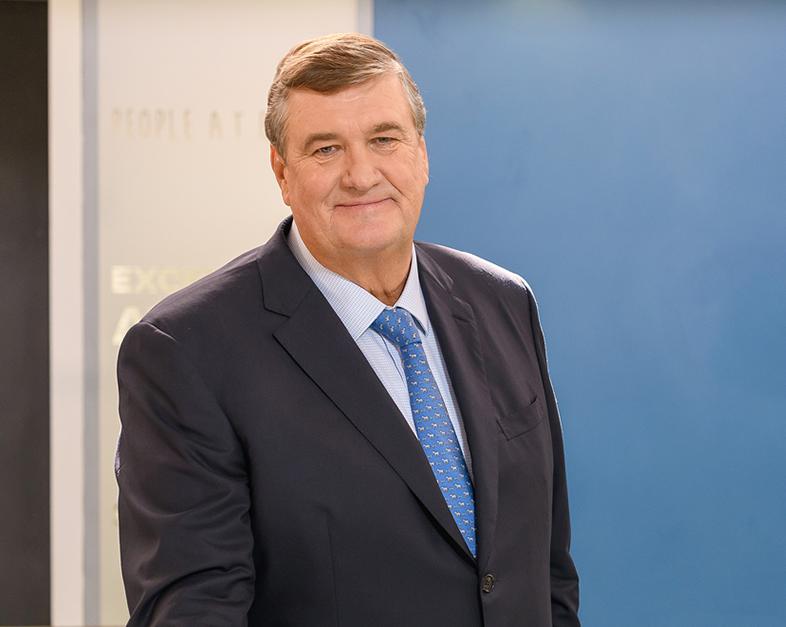
“I have had the privilege of contributing to the Group’s development alongside committed and visionary teams.”P. Arnaud DalaisOn stepping down as Chairman of CIEL Limited, published by CIEL Group, 2025.
iv Leadership identity
What the record
suggests about method.
This section is analysis — an editorial reading of publicly documented facts, prepared by this site’s editorial desk. It is not biography, and nothing in it should be read as a statement by Mr Dalais.
01
Duration as a strategy
Forty-eight years in one group, thirty-four of them at the top, is a highly unusual profile among leaders of listed companies. It permits a kind of decision-making that quarterly-reporting logic does not: committing capital to businesses whose returns arrive after the leader who authorised them has moved on. The textile, healthcare and finance clusters were each built on that horizon.
02
Diversification as risk management
A group of CIEL’s scale, based in a small island economy, faces concentrated exposure: to one currency, one labour market, one weather system, one set of trade preferences. Six clusters across ten markets, with roughly half of revenue earned in hard currency, is the structural answer to that exposure. Read this way, diversification is less about ambition than about survival engineering.
03
Negotiation over confrontation
Chairing the Joint Economic Council and later Business Mauritius meant representing employers, exporters, banks and hoteliers with competing interests, and then negotiating with government on behalf of all of them. The headline given to his 2017 Le Mauricien interview — that dialogue, not confrontation, is what moves things forward — is consistent with the roles themselves.
04
Succession as a designed process
His own arrival at the top in 1991 followed a documented generational handover. His departure from the chair in 2025 followed the same pattern: Guillaume Dalais became Group Chief Executive on 1 January 2024, and Jean-Pierre Dalais took the chair eighteen months later. Two transitions, sequenced rather than simultaneous.
05
Institutional over personal
The public footprint is notably thin for someone of this seniority: board biographies, corporate results, occasional press interviews. There is no visible personal-brand apparatus. Whether by temperament or by design, the institution is the thing that carries the name.
06
Governance as inheritance
The 2014 reorganisation that produced CIEL Limited consolidated the Group under one listed vehicle with a single board. For a family-anchored business, that is a decision to accept external scrutiny in exchange for access to capital — and it constrains successors as much as it enables them.
v Professional significance
Where this career
sits in the Mauritian story.
Mauritius is routinely cited as one of the more successful post-independence economic transitions in Africa. It moved from sugar monoculture to export manufacturing, then added tourism, then financial and professional services, and more recently information and communication technology. By 2024 the country recorded a nominal GDP of roughly USD 16.4 billion and GDP per capita of about USD 12,973 — upper-middle-income by World Bank classification, having briefly been reclassified as high-income in July 2020 before reverting in 2021.
That transition did not happen only in policy. It happened inside companies. The capital, the land, the management depth and the banking relationships that had been assembled during the sugar era had to be redeployed into entirely different industries — and someone had to decide, repeatedly and without certainty, which industries those would be.
The significance of a career like this one is that it sits precisely at that decision point, for an unusually long time. Between 1991 and 2025, the person accountable for CIEL’s capital allocation was the same person. Textile production expanded into Madagascar, India and Bangladesh. Hospitality assets were developed and later restructured under a separate listed vehicle. Healthcare was built into a cluster of hospitals, clinics and laboratories. Financial services grew into banking, fiduciary and asset-management activity across several territories.
Each of those was a bet on where a small island economy could compete. Not all such bets, in Mauritius or elsewhere, worked out; the ones that did compounded over decades.
There is a second dimension, harder to quantify. Chairing the Joint Economic Council and Business Mauritius meant participating in the mechanism by which Mauritian economic policy is actually negotiated — a small, consultative system in which a comparatively small number of private-sector figures sit repeatedly across the table from government. Institutional continuity of that kind is part of why Mauritian policy has tended to be predictable, and predictability is much of what a small jurisdiction has to sell to international investors.
vi Sources & verification
Where the facts on this page come from
- CIEL Group — board biography and corporate announcement, “Jean-Pierre Dalais succeeds P. Arnaud Dalais as Chairman of CIEL Group”, 2025.
- CIEL Group — Board of Directors & Committees and About the Group.
- RIVEO — Board of Directors: P. Arnaud Dalais, board biography listing dates, roles and stated competencies.
- Le Mauricien — interview with Arnaud Dalais as President of Business Mauritius, 10 September 2017.
- CIEL Limited financial results and Stock Exchange of Mauritius filings for the year ended 30 June 2025.
- World Bank and Government of Mauritius statistics for national economic figures; see Mauritius & Global Context for detail.
Where a claim could not be verified against a credible public source, it has been omitted rather than estimated. No personal, family or financial details are published here.