04 Business & enterprise
Six clusters,
ten markets,
one balance sheet.
This page describes the enterprise in which Arnaud Dalais spent his career. It is a profile of the organisation, its documented structure and its published results — not a claim about personal ownership or control.
i Origins
A company that began
as four thousand hectares
of sugar cane.
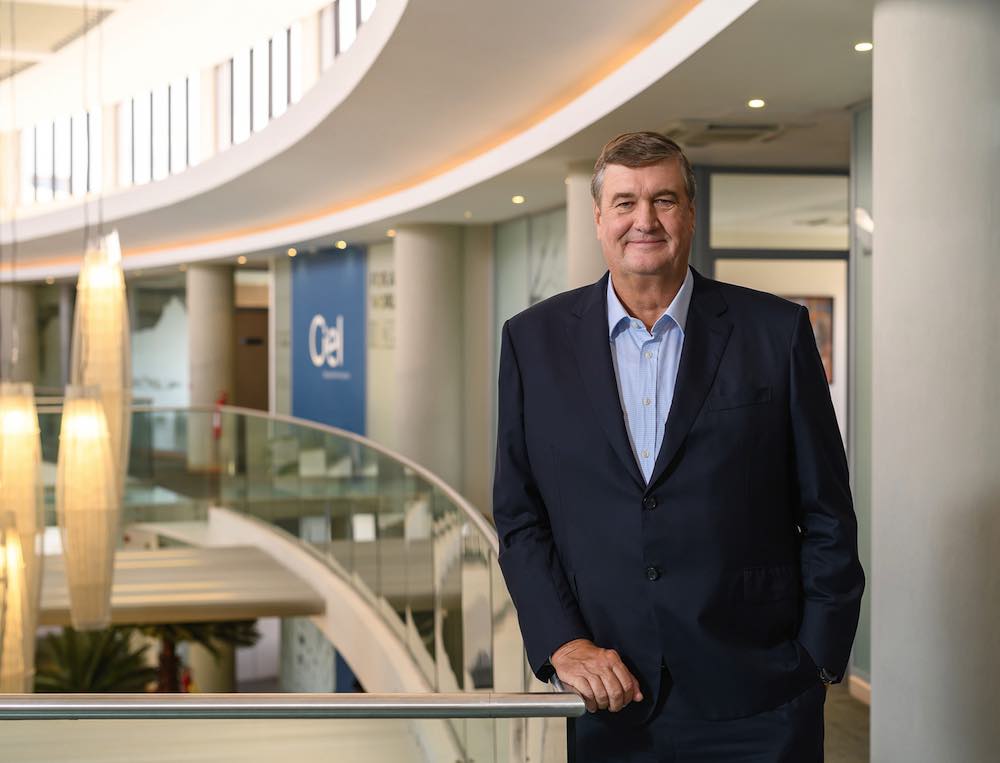
CIEL was created in 1912 and, in the words of its own corporate history, has been deeply linked with the sugar industry since its creation. Its foundation lies in Deep River-Beau Champ — an estate in the east of Mauritius cultivating some 4,000 hectares of cane. Growth in that era followed the standard pattern of the colonial sugar economy: acquisition of neighbouring land, and the centralisation of milling into fewer, larger factories.
That inheritance matters for two reasons. The first is capital. Sugar estates generated durable cash flows and, critically, held land — the collateral that later financed factories, hotels and hospitals. The second is management. Running an integrated agricultural business across thousands of hectares, with a seasonal workforce and an export market denominated in a foreign currency, is not a simple undertaking. The disciplines it teaches — long planning cycles, capital-intensity, tolerance for cyclicality — transfer surprisingly well into hospitality and manufacturing.
The corporate identity followed the transformation only later. Until January 2014 the Group’s listed vehicle still carried the name Deep River Investment Limited; it was renamed CIEL Limited in that month, as part of the reorganisation examined further down this page.
The Group marked its 110th anniversary in 2022, in a year in which it reported a revenue increase of more than 50 per cent as post-pandemic activity recovered across its hospitality and textile operations.
ii The six clusters
What the Group
actually does.
CIEL reports six strategic sectors. Each was built at a different moment, for a different reason, and each carries a different risk profile. Together they are the answer to a structural problem: how a company based on a small island diversifies away from a single point of failure.
The original business, and the land beneath it
Agriculture is where the Group began, and property is what agricultural land became. In Mauritius, the conversion of sugar estate land into residential, commercial and resort development has been one of the defining corporate stories of the past three decades. The two are reported together because, economically, they are the same asset viewed at two points in its life.
Manufacturing that outgrew the island
CIEL’s textile operations manufacture knitwear, woven and fine-knit products, and are reported as employing more than 21,000 people across four countries. This is the cluster that most clearly demonstrates the export logic: Mauritius pioneered export-processing garment manufacture in the 1970s and 1980s, then lost its cost advantage as wages rose — so production moved to Madagascar, India and Bangladesh while design, client relationships and management remained anchored in Mauritius. It is a textbook case of a small economy moving up a value chain rather than defending an eroding one.
Banking, fiduciary services and asset management
The financial-services cluster provides banking, portfolio management and fiduciary products, and is reported as employing around 1,600 people across four territories. Its existence reflects the single largest structural change in the Mauritian economy since independence: the emergence of the island as an international financial centre, a sector estimated at roughly 13.3 per cent of national GDP in 2024.
Hospitals, clinics and laboratories
The healthcare cluster operates hospitals, primary and secondary care clinics, laboratories and collection centres. Private healthcare is a long-duration, capital-heavy business with a domestic revenue base — the structural opposite of export textiles. Holding both inside one group is deliberate: their cycles do not coincide.
The most cyclical exposure in the portfolio
The Group’s tourism and hospitality activities are grouped under CIEL Hotels & Resorts, which brings together its resort interests in Mauritius and beyond. Arnaud Dalais chaired the board of SUN, the Group’s listed hospitality company, from February 2011 to 2017. Hospitality is where a Mauritian group is most exposed to events entirely outside its control: airline capacity, currency, global travel sentiment, and the weather.
The centre that allocates
Reported as a segment in its own right, the corporate centre is where the essential work of a diversified group happens: deciding which cluster receives capital, which is asked to return it, and which is held through a downturn. This is the function a group chief executive and, later, a group chairman exists to superintend.
iii The published numbers
Results for the year
ended 30 June 2025.
The final financial year of Arnaud Dalais’s chairmanship. All figures below are as reported by CIEL Limited.
Reading the shape of the business
Three characteristics stand out in the reported position. The first is scale relative to the domestic economy. At the rupee-dollar rate implied by the Group’s own disclosure — a market capitalisation of MUR 14.3 billion described as about USD 316.5 million — revenue of MUR 38.03 billion is on the order of USD 0.8 billion, against a national GDP of roughly USD 16.4 billion in 2024. A single group turning over the equivalent of a mid-single-digit share of national output is what significance looks like in a small economy.
The second is currency. CIEL reports earning approximately half of its revenue in US dollars, sterling and euros. For a company whose costs are substantially in Mauritian rupees, that is a natural hedge of considerable value — and it is the direct consequence of the export and international expansion strategy.
The third is the gap between the market’s valuation and the operating scale. Market capitalisation was reported at MUR 14.3 billion, or about USD 316.5 million, at 30 June 2025 — a fraction of annual revenue. That relationship is common among diversified holding companies, which frequently trade at a discount to the sum of their parts, and it is one of the standing arguments in favour of clearer group structures.
The Group reports employing more than 38,000 people across roughly ten markets in Africa and Asia. In workforce terms, that makes it one of the larger private employers headquartered in Mauritius.
Sources — CIEL Limited results for the year ended 30 June 2025, Stock Exchange of Mauritius filings and CIEL Group corporate communications. Currency conversions are as published by the Group. Figures are historical and are not a projection of future performance.
iv Case study
January 2014: Deep River Investment Limited becomes CIEL Limited.
When a company
renames itself, it is
rarely about the name.
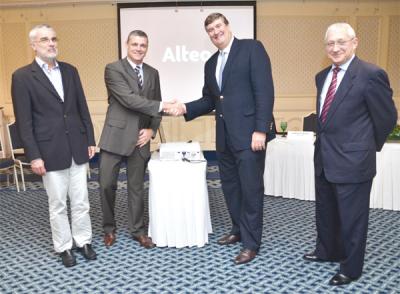
In January 2014, the listed entity formerly known as Deep River Investment Limited was renamed CIEL Limited, as part of a reorganisation of the Group. Arnaud Dalais, who had been Group Chairman since 2010, became Chairman of the reorganised listed company.
The problem being solved. Diversified groups that grow by accretion tend to accumulate structural complexity: several listed vehicles, cross-holdings, minorities in operating subsidiaries, and a parent whose share price bears an unclear relationship to the businesses beneath it. Investors discount what they cannot model. Analysts cover what they can explain.
The intervention. Consolidating the Group’s interests under a single quoted holding company, and giving that company the Group’s own operating name, aligns three things that had drifted apart: the legal entity, the commercial brand and the investment story. It also concentrates governance — one board, one audit committee, one disclosure obligation.
The cost. Consolidation removes optionality. Separate vehicles can raise capital independently, be partially sold, or be valued on their own merits. A single holding company gives that up in exchange for clarity, and accepts that the market will apply one multiple to businesses as different as a hospital group and a garment manufacturer.
The evidence since. By the year ended 30 June 2025 the Group was reporting MUR 38.03 billion of revenue across six clusters and roughly ten markets, with the structure that emerged from 2014 still intact and with the chairmanship transferred inside it in an orderly, pre-announced sequence. Whether the reorganisation closed the holding-company discount is a separate question, and the reported market capitalisation of MUR 14.3 billion at that date suggests the discount has not disappeared.
Editorial analysis — The dates, names and figures above are documented. The interpretation of why the reorganisation was undertaken is this site’s reading of the public record, not a statement by the Group or by Mr Dalais.
v Sustainability & capital
When sustainability
is priced into the debt.
In September 2025 CIEL raised MUR 1.45 billion — approximately USD 31 million — through a sustainability-linked bond. The issue was reported as 1.5 times oversubscribed. Its terms are tied to three measurable commitments spanning the Group’s six clusters: increasing women’s empowerment, cutting carbon emissions, and reducing water consumption.
The distinction between a sustainability-linked bond and a conventional one is not cosmetic. A sustainability-linked instrument attaches financial consequences to the issuer’s performance against defined targets: miss them, and the cost of the borrowing changes. It converts stated intention into a contractual obligation priced by the market.
The transaction was structured with MCB Capital Markets, assessed independently by Morningstar Sustainalytics, and supported by FSD Africa, with participation from the Africa Local Currency Bond Fund. CIEL Limited is a constituent of the SEM Sustainability Index on the Stock Exchange of Mauritius.
Separately, the CIEL Foundation was established in 2004 and marked twenty years of operation in 2024, reporting partnerships with more than sixty non-governmental organisations and the launch of a four-month NGO leadership programme in July 2024.
The 2025 sustainability-linked bond
MUR 1.45 billion (approx. USD 31 million)
Reported 1.5× oversubscribed
Increasing women’s empowerment across the Group
Reduction in carbon emissions
Reduction in water consumption
MCB Capital Markets; Morningstar Sustainalytics; FSD Africa; Africa Local Currency Bond Fund
September 2025
vi The documented relationship
Stated precisely, and no further
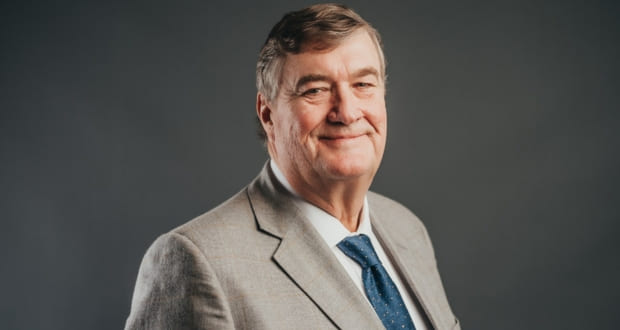
Arnaud Dalais joined the CIEL Group in August 1977, was appointed Group Chief Executive and Director in November 1991, became Group Chairman in 2010, and served as Chairman of CIEL Limited from the 2014 reorganisation until 1 July 2025. He chaired the board of SUN from February 2011 to 2017. He remains a non-executive director of CIEL Limited and sits on its Investment Committee, and is a non-executive director of RIVEO.
Beyond those documented offices, this site makes no claim regarding shareholdings, beneficial ownership, control, remuneration or personal wealth. Media estimates of such figures exist; they are estimates, not disclosures, and they are not reproduced here.